Skip to content

AI-Guided Food Processing Automation

Every Eggplant Is Different.

PRODUCT IN FRAMEOBJECT IDEGG-0400

The Cut Should Be Too.

Machine vision finds the stem. The robot removes it. In real time.

Built for industrial food processing.

Throughput
up to 2 pcs/sec

Why vision, not just automation

A fixed blade sees every eggplant the same.We don't.

A cutter at a fixed position needs the product brought to it. That is why conventional machines still need an operator at the infeed — someone has to make every eggplant look like the one before it.

Fixed assumptionOne cutting position is chosen once and applied to everything. The product has to adapt to the machine — which is why someone has to stand at the infeed.

Calculated positionEach product is detected and its own cutting position is calculated. The machine adapts to the product, so nobody has to make the products match.

Conventional process

  • Product dimensions vary
  • Stem position varies
  • Orientation varies
  • A fixed cut can remove usable product
  • Inconsistent results between products

Doktek AI process

  • Each product is inspected individually
  • Stem position is detected
  • A cut line is generated per product
  • Robotic motion adapts to each product
  • The same logic applies to every one

Vision → Decision → Motion → Cut

Four things happen to every single product.

Not once per batch and not once per shift. Every eggplant that enters the machine is looked at, measured, decided about and cut on its own terms.

  1. 01

    Vision

    CAMERA FRAME

    A camera captures each product as the belt carries it past.

  2. 02

    Decision

    GEOMETRY · ORIENTATION · STEM

    Software finds the product, its geometry, its orientation and its stem.

  3. 03

    Motion

    COORDINATE TRANSFORM

    The cut position is transformed from image space into robot space.

  4. 04

    Cut

    ROBOT FRAME

    The robot intercepts the product on the moving belt and cuts.

  • Camera frame
  • Geometry
  • Keypoints
  • Cut line
  • Robot target
  • Cut
01PRODUCT IN FRAME

It starts with an eggplant.

No two are the same. Different length, different curve, different stem angle — and they arrive lying however they landed.

02SCANNING

Machine Vision Finds the Stem

The vision system analyzes every product individually and determines the cutting position automatically.

03COORDINATES SENT

The Robot Knows Where to Move

Vision coordinates are transformed into real-time robotic motion.

04TOOL IN POSITION

One Precise Cut.

The cutting unit is positioned per product, not per batch — the blade meets the stem where the vision system said it would be.

05CYCLE COMPLETE

Cut Only What Needs to Be Cut.

Reduced product loss. Consistent processing. Continuous operation.

01
02
03
04
05
Machine vision

The Machine Doesn't Just See the Eggplant.It Understands It.

Computer vision detects product geometry, analyses stem location and sends cutting coordinates to the automation system in real time.

  • OBJECT

    Product isolated from the belt

  • GEOMETRY

    Length, width and curvature

  • ORIENTATION

    Long axis measured in frame

  • KEYPOINTS

    Calyx and shoulder located

  • CUT LINE

    Computed for this product alone

  • TRANSFORM

    Image space into robot space

Coordinate transform
Image spaceRobot spaceu612 pxX428.4 mmv344 pxY216.7 mmθ+13.0°Z82.0 mm

Interface illustration — values shown are the ones in the animation at the top of this page.

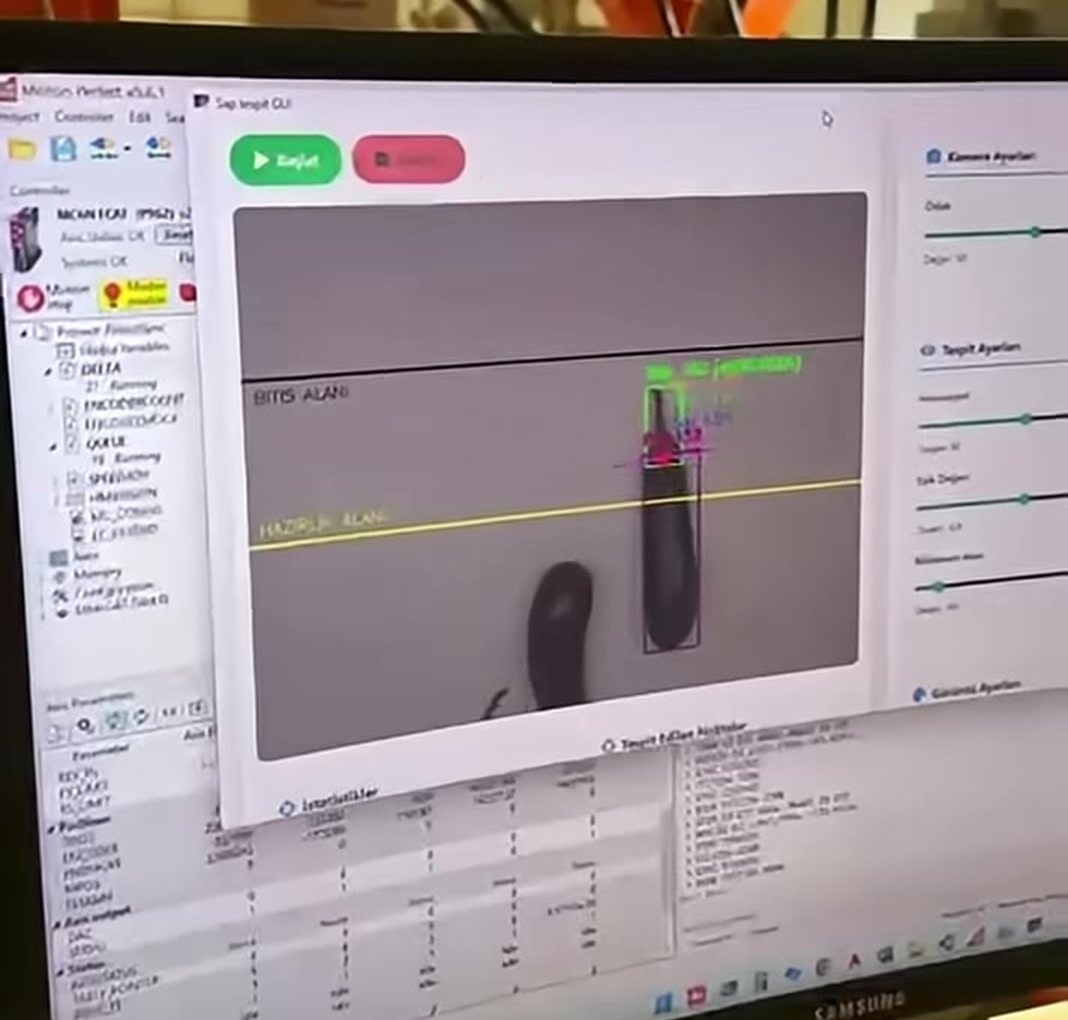
DOKTEK stem-detection interface showing an aubergine with its detection box, calyx keypoints and computed cut line
The real stem-detection interface during a production run — detection box, keypoints and computed cut line.

How it works

Five steps, one continuous flow

  1. 01

    Feeding

    Eggplants enter the system continuously.

  2. 02

    Detection

    Machine vision identifies the product and determines the cutting position.

  3. 03

    Position Analysis

    The software calculates stem orientation and cutting coordinates.

  4. 04

    Automatic Cutting

    The robotic / automated cutting system performs the cut.

  5. 05

    Continuous Production

    Processed eggplants continue automatically to the next production stage.

The complete system

Engineered for the factory floor.

Vision, motion, cutting and control are not four bought-in boxes bolted together. They are engineered as one machine, and they are why the product on the belt never has to be touched by hand.

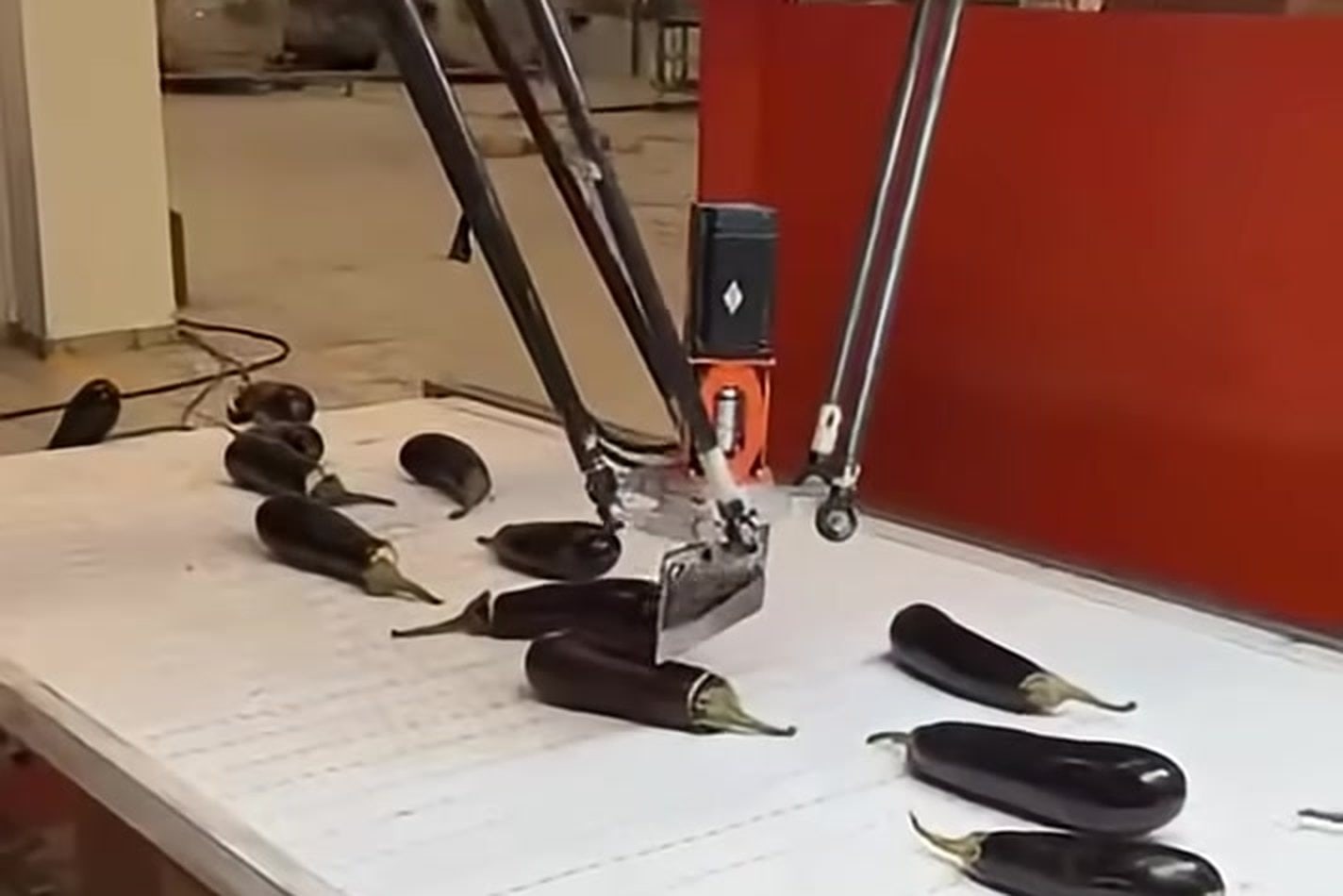
DOKTEK FoodTech automatic eggplant stem cutting machine with machine vision detection
AI Vision SystemDetects each product and locates the stem.
Product ConveyorContinuous infeed, no indexing or fixturing.
Robotic HandlingHigh-speed delta kinematics carry the tool.
Automatic Cutting UnitCut placed per product, on the move.
Industrial Control SystemMotion, vision and I/O under one controller.
Food-Grade ConstructionBuilt for wash-down production areas.

Frame from the machine's own demonstration video.

Designed & built by Doktek Technology

Validation

From computer vision to real production.

Everything above is easy to claim and hard to prove. This is the machine itself: the same product, at four stages of one cycle.

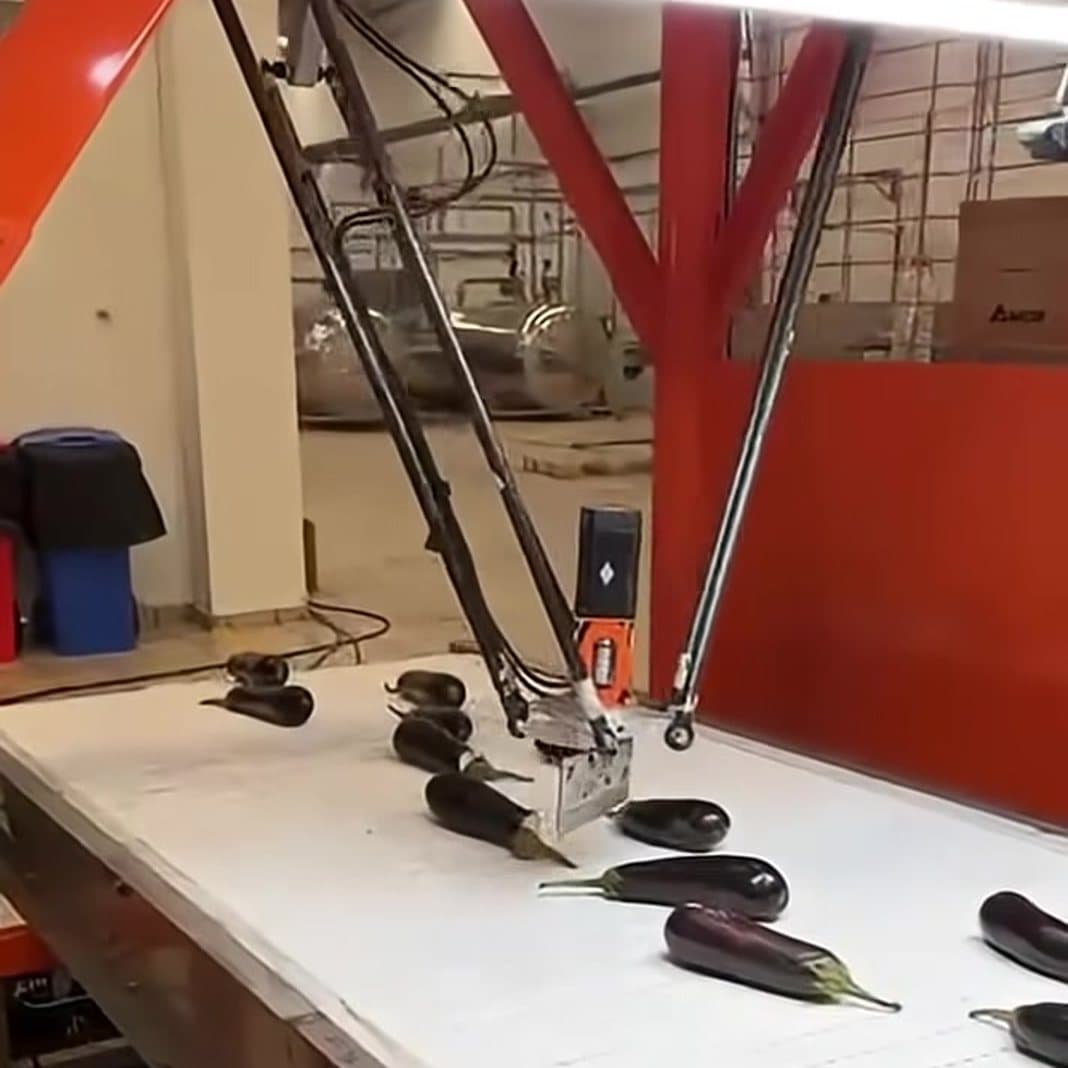
Eggplants travelling on the machine's infeed conveyor
Real camera

What the camera sees

Product on the conveyor, lit and framed for the vision system.

Frames from Doktek's own machine demonstration video.

Industrial maturity

Built for the factory floor.

The parts of a machine nobody photographs are the parts that decide whether it survives a season.

01

Industrial motion control

Motion, vision and I/O run under one industrial controller.

02

Continuous conveyor operation

Product is processed on the move — no indexing, no fixturing.

03

Food-contact construction

Stainless construction intended for wash-down production areas.

04

Serviceable cutting assembly

The cutting head is built to be reached, inspected and re-bladed.

05

Operator controls

An industrial HMI for supervision, not a laptop on a crate.

06

Line integration

Designed to sit between an upstream feed and a downstream process.

Specification

Designed for production.Measured by output.

Figures below are published only once DOKTEK has confirmed them against a real machine. Anything not yet confirmed is absent rather than estimated.

Operating mode
Continuous
Vision system
Camera-based product detection

Specification in progress

Remaining figures are confirmed against your product and line configuration. Send us your requirement and we will return a specification for it.

Capacity

What would this do on your line?

Enter your own operating assumptions. The result is arithmetic on your numbers, not a performance claim about the machine.

pcs/s
h
kg
Pieces / hour
7,200
Pieces / day
57,600
kg / hour
2,160
Tonnes / day
17.3

Estimates calculated from the values you entered. Actual throughput depends on product dimensions, incoming orientation, conveyor configuration and line integration.

Business case

Could automation pay back in your factory?

This works out what the manual task costs you today. It does not claim a payback period — that depends on a machine configuration and a price, and both come from a conversation.

Currency is whatever you enter — the arithmetic is the same.

Manual labour cost / month
3,200
Manual labour cost / year
38,400
Operator-hours / month
704

Estimates from your inputs only. Doktek publishes no payback period, and no machine price is assumed here.

Product yield

Cut only what needs to be cut.

A fixed cutting position has to be set deep enough for the most awkward product in the batch. Every product that was not the awkward one pays for that margin — in usable flesh, every hour the line runs.

Fixed position
Calculated per product

Yield figures are not published here. What is lost to a fixed cut depends on your product and your current setting, and it is measured on your samples — not estimated on ours.

Stainless-steel conveyor and frame of the Doktek eggplant cutting machine
Frame from the machine's demonstration video.

Food processing environments

Designed for food processing environments.

A machine that cannot be cleaned quickly is a machine that slows the line down every single day.

  • Stainless-steel construction

    Built from stainless steel for wash-down production areas.

  • Hygienic architecture

    Laid out to avoid places where product can collect.

  • Access for cleaning

    Cleaning areas reachable without stripping the machine.

  • Food-contact surfaces

    Product-contact parts specified for food processing use.

  • Service access

    Maintenance points reachable from the working side of the line.

Material specifications and certification are confirmed per project. We do not publish certification claims that have not been issued.

Service

Serviceable by design.

A cutting machine is a wear machine. What matters is how quickly the wear parts come out.

How is the blade replaced?
The cutting assembly is built to be reached from the working side of the line for inspection and blade change.
Which parts are wear parts?
The blade and product-contact components are the expected wear items. The full list is issued with the machine documentation for your configuration.
How often is service expected?
Service intervals depend on product abrasiveness, running hours and cleaning regime, and are confirmed for your configuration rather than quoted generically.
Can operators access the cutting assembly?
Access for routine inspection is part of the machine layout. Task-by-task responsibilities are agreed during commissioning.

Doktek does not publish generic service intervals. They are agreed against your product and running hours, and written into the machine documentation.

Line integration

Built to become part of the line.

The machine is one stage. What matters commercially is what it sits between.

Upstream feed
  • Reception
  • Washing
  • Feeding
DOKTEK

Doktek stem cutting

Next process
  • Inspection
  • Slicing / dicing
  • Freezing
  • Pickling
  • Canning
  • Packaging
Interfaces

Digital I/O

Start, stop and interlock signals to the line.

Production counter

Processed product count available from the controller.

Alarm interface

Fault and status signalling for line supervision.

Operator HMI

Local supervision and machine settings.

Industrial communication protocols, recipe management and remote diagnostics are scoped per project. Tell us what your line speaks and we will confirm what is possible.

Discuss integration

The company

Engineering Machines for Problems That Were Previously Manual

Doktek Foodtech combines mechanical engineering, robotics, industrial automation, machine vision and software to automate complex food-processing operations.

Machine engineeringComputer visionRoboticsDOKTEK FOODTECH
  • Mechanical Engineering
  • Robotics
  • Machine Vision
  • Automation
  • Software
DOKTEK FOODTECH

The platform

One Machine Is Just the Beginning.

We are developing intelligent automation technologies for vegetable and food-processing applications where conventional machinery cannot easily handle product variation.

  • 01Vegetable stem cutting
  • 02Product orientation
  • 03Vision-guided processing
  • 04Robotic food handling
  • 05Sorting
  • 06Inspection
  • 07Custom automation

Technology areas under development — not a catalogue of finished machines.

International

Built in Türkiye. Designed for Global Food Production.

Eggplant is grown and processed at industrial scale across the Mediterranean, Europe and the Middle East. Wherever it is topped by hand today, it can be automated.

Engineering & manufacturingTürkiye
Discuss Your Production Line
TürkiyeItalySpainNetherlandsBelgiumBalkansMiddle EastNorth AfricaProcessing regions

Questions

What buyers ask first.

The answers below say what is known and say so when something is confirmed per project.

01Does every eggplant need to be positioned in the same direction?

No. Products are fed onto the conveyor without manual alignment. The vision system establishes each product's position and orientation, and the cutting position is calculated for that product individually.

02Why use machine vision instead of a fixed blade?

A fixed blade applies one cutting position to every product. Eggplants vary in length, curvature and stem position, so a single position takes too much from some and leaves stem on others. Vision calculates the position for each product instead of assuming one.

03How fast can the system process eggplants?

Throughput depends on product dimensions, incoming orientation, target cutting geometry and conveyor configuration. Send us your product and target capacity and we will evaluate the configuration for your line rather than quote a figure that may not apply to it.

04What happens when eggplants have different sizes?

Each product is measured rather than matched against a fixed template, so size variation is handled without changing settings between products. The size range a given configuration covers is defined during application engineering.

05Does the machine require an operator?

The cutting operation is automatic. Supervision, product supply and cleaning remain operator tasks, and how much attention the machine needs depends on how it is integrated into your line.

06How is the cutting blade maintained or replaced?

The cutting assembly is designed to be reached for inspection and blade replacement. The procedure, wear parts and service intervals are issued with the machine documentation for your configuration.

07Can the machine integrate with an existing processing line?

Yes. It is designed to sit between an upstream feed and a downstream process, with digital I/O, a production counter and alarm signalling to the line. Specific protocols are confirmed per project.

08Can you test our eggplants before we order?

Yes, and we would rather you asked. Send samples, photographs or a short video of your product and our engineering team will evaluate whether the process can be automated for it.

09Can the system be configured for different eggplant varieties?

The system works from detected product geometry rather than a stored template, so varieties that differ in size and shape are addressed during application engineering using your samples.

10What happens if the vision system cannot confidently identify a product?

How unidentified products are handled — passed through uncut, diverted, or returned for manual handling — is defined during application engineering, because the right answer depends on what the rest of your line does next.

11How is the machine cleaned?

The machine is built from stainless steel for wash-down production areas, with access to the cleaning zones. The cleaning method and regime are confirmed for your configuration and production hygiene requirements.

12Is remote technical support available?

Support arrangements are agreed as part of the project. Tell us what your operation needs and we will confirm what we can commit to in writing.

13Can Doktek design feeding and discharge systems as part of the project?

Yes. Doktek designs and manufactures industrial machines, so feeding and discharge can be scoped into the project rather than left for you to source separately.

Still Cutting Eggplants Manually?

Let's Automate It.

Start here

Your eggplant.Our machine.Let's test it.

Every processor handles a different product. Send us your eggplant samples or production specifications and our engineering team can evaluate the application.

Have photos or a production video? Send them on WhatsApp or by email and we will pick the thread up from there.

About you
About your product
About your line
What would you like from us?

We use what you send only to answer your enquiry.